
About CMS
The Canandaigua Medical Society was founded December 13, 1864 at the office of Dr. J.T. Swart. A week later the constitution was adopted, establishing CMS’s founding purpose: "to promote the scientific improvement and social fellowship of its members; to preserve the unity and to maintain the dignity and honor of the profession."
More than 160 years later, this purpose still lies at the heart of the Canandaigua Medical Society.
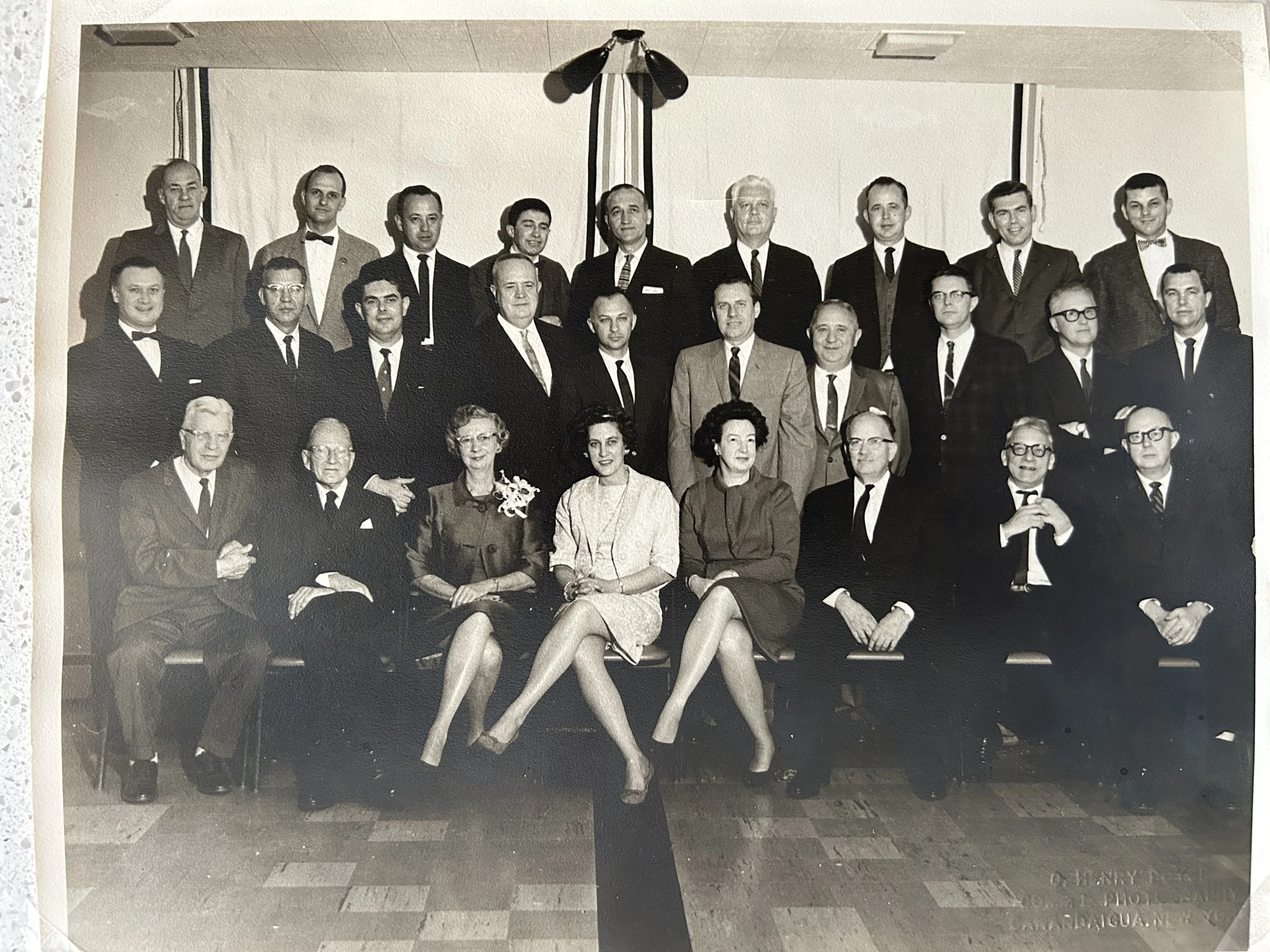
A Brief History of the
Canandaigua Medical Society
Presented on the Occasion of the Celebration of the Society’s 150th Anniversary
May 2, 2014 at the Canandaigua Yacht Club
Robert J. Ostrander, M.D.
Esteemed Fellow Members and Honored Guests,
It is a privilege to have the opportunity to share with you tonight some history and stories of the practice of medicine in the Canandaigua area and especially of our Society. I have shamelessly taken many of my remarks from the excellent paper presented to the Society at its 100th anniversary meeting in January 1964 by Dr. C. Harvey Jewett.
I will follow Dr. Jewett’s lead and make a few comments about the medical profession in the area before 1864. In the summer of 1790 one of the early settlers on the lands of the Phelps and Gorham purchase was taken seriously ill. (The Phelps and Gorham purchase was a complicated transaction for land in this area involving Judges Phelps and Gorham, The States of Massachusetts and New York, and the Iroquois Nations that had sided with the British.) In any case, there was no physician in the Village of Kanandarqua, so a Dr. William Adams was summoned from Geneva. He arrived without any medicine and it was told that he broke open a chest which had been left by some itinerant traveler and found some remedies which he used. The patient died, nonetheless. Curiously enough, Dr. Adams led the funeral procession and in this instance officiated as the clergyman, thereby starting a strange custom which lasted for nearly 100 years of having the physician lead the procession.
Soon after this Judges Phelps and Gorham brought the first physician, Dr. Moses Atwater to Kanandarqua. Dr. Atwater was a graduate of Yale, Class of 1787 and was one of the organizers and the first president of the Ontario County Medical Society, which was founded in 1806. Contemporaries of Dr. Atwater included Dr. William Williams and Dr. Samuel Dungan. Dr. Williams was also a Yale graduate and described as “advanced thinker,” so much so that he took a stand against the prevailing treatment of bloodletting, feeling that it produced great debility and prolonged recovery.
The world is a wider place than it was in 1964, and I will take the liberty of mentioning a couple key aspects of medical history from beyond Canandaigua’s borders. I would be remiss if I did not discuss at least one figure from my little village. Marcus Whitman was born in Federal Hollow, now Rushville, in 1802. He moved away to live with relatives, when he was seven, after his father died. He wanted to be a minister, but he could not afford the education. Instead, in 1825, he enrolled in the College of Physicians and Surgeons of the Western District of New York - Fairfield; after sixteen weeks, he was qualified for a license to practice medicine. He went to Canada to practice medicine, spending about 2 ½ years in the Niagara District before returning to Rushville. His thoughts again turned to ministry, and he entered preparatory study to become a minister. His studies for the ministry were cut short by illness and never completed. However, in October 1831 he again entered College of Physicians and Surgeons, Fairfield, and achieved his Medical Doctor (M.D.) degree. He was considered to be a very capable and qualified doctor of medicine with his two degrees and experience in being a physician.
After receiving his M.D., Marcus settled in Wheeler, New York, where he lived until 1835, when he left to scout for mission stations in Oregon. He and his wife Narcissa Prentiss Whitman, born in Prattsburg, are famous for their role in the early movement of white settlers into the Oregon Territory.
Any discussion of the history of medicine in the area would be seriously flawed if it failed to mention Dr. Elizabeth Blackwell. Elizabeth Blackwell was born in England, and moved with her family to the United States as a child. Dr. Blackwell is recognized as the first woman graduate of a U.S. Medical School. After being rebuffed by the medical schools in the Philadelphia area, her first choice, she was accepted in 1847 into the Geneva Medical College. She graduated in 1849, and practiced and taught in New York City and Europe.
Finally, before embarking on a review of the specific history of our Society, I will touch on Dr. Henry Foster and the founding in 1849 of the Clifton Springs Sanitarium, where I was born. Dr. Foster was part of the movement of young physicians against the harsh cures of early 19th century medicine. He set out to build a Clinic where therapy would be focused on the healing powers of water (in this case sulfur water!), healthy foods and faith, explicitly recognizing the connection between mind and body in disease. In its heyday in the late 19th and early 20th century, patients came long distances for the cure. My grandfather was a chef there in the 1940s and 1950s, and my father worked in high school as a bellhop for wealthy patients. I remember as a child walks through the park with a swan pond, fountains to drink fresh and sulfur water, a golf course and tennis courts on the grounds and a bandstand on the hill.
In the words of Dr. C. Harvey Jewett, “But I must move on to the organization of our Society and I quote from the original minutes as follows: ‘At a meeting of the members of the Medical Profession of the Village of Canandaigua held at the office of Dr. J. T. Swart Tuesday Dec. 13 1864 on motion of Dr. Hayes, Dr. H. Jewitt was elected chairman and Dr. Smith was elected Secretary.’” The object of the meeting was to discuss the feasibility and propriety of forming a Village Medical Society. Those present were unanimously in favor and a committee to draft a constitution was appointed.
The constitution was adopted at a meeting one week later, establishing what was originally called “The Society of Physicians of the Village of Canandaigua.” Of particular interest is Article II: “The object of this Society shall be to promote the scientific improvement and social fellowship of its members; to preserve the unity and to maintain the dignity and honor of the profession.” At an address to the Society sixty-eight years later, Dr. John H. Jewett, referring to Article II, noted, “To one portion of the second article I ask your special attention, ‘To promote the social fellowship of its members.’ To that end the meetings were held at offices and houses of members and by common consent they gathered around a table and were bountifully served of good things to eat. This eating and meeting together has been the means of cultivating harmony among the members and avoiding the unseemly and much to be deprecated enmity and jealousy which exists in so many communities the size of Canandaigua.” Article IX is also noteworthy, “It shall be the duty of all members to be present at the regular meetings and contribute to their interest, or render a satisfactory excuse that or the subsequent meeting, a neglect of which shall be deemed a misdemeanor.”
At this point, I think it will be interesting and entertaining to review some of the topics of conversation in those early years.
In February of 1865, at the second regular meeting of the society, Dr. Simmons presented two cases of “the happy effect of a very large dose of opium given in convulsions in children. The medicine in both cases was given for the producing of euthanasia or an easy termination of life in a desperate case had the contrary effect of restoring health.” At the next meeting it was voted that each member should make a black list of such persons in his practice as were able to pay but refused to and should furnish such list to the secretary who should place it in the records of the Society for the information and benefit of its members. In the early years meetings typically alternated between papers and case reports. Interestingly, I found no mention in the minutes of the end of the Civil War or Civil War medicine.
In August of 1871 Dr. Carson described a case of excessive secretion of urine in a patient whose specific gravity was only 1.004 and the urine was not “charged with sugar or albumin.” In describing this in his 1964 address Dr. Jewett noted that “in an old Oslers Text Book of Medicine the distinction between saccharin and non-saccharin forms of diabetes was first described in 1674, but evidently the case was not recognized by members of the society and Dr. Carson treated the patient with bran cakes and thistle water.” At this same meeting there was an early discussion of the germ theory of disease in relation to epidemics and contagious diseases, but the membership was very critical. It was not until four years later when Dr. Carson read a paper on “A Synopsis of the Observations of Modern Pathologists on the Germ Theory of Disease” that is was given much credence.
In March 1880 Dr. Harvey Jewett read a paper on Hygiene stressing the importance of public health. He felt that most epidemic diseases could be prevented by strict hygienic measures promoted by local boards of health. In the discussion of the paper that ensued one of the members thought that noxious gases were more productive of disease than impure water. Dr. Swart considered sunlight the most valuable hygienic agent and did not believe filth and dirt was as prolific a cause of disease as claimed in the paper. It was also in 1880 that the Society adopted the following resolution: “That we, the members of the medical profession in Canandaigua disapprove of the prevailing custom of leading funeral processions and henceforth are determined to discontinue this inconvenient and unnecessary practice.” At the July 1880 meeting, Dr. John Jewett, fresh out of medical school, discussed the metric system showing its great advantages in medicine in order to avoid errors in small dosage measures and predicting that the day was not far distant when all nations would adopt the metric system of weights and measures.
In December 1892 the Society was officially incorporated under the laws of New York. A copy of the Seal is in the Minutes book.
In February of 1897, about one year after Professor Roentgen’s discovery of the XRay a proposition was made to the Society that the physicians of the Village subscribe the sum of sixty dollars toward an XRay apparatus for the Union School, the state to pay an equal amount. At the next meeting it was announced that an XRay coil, tube and fluoroscope had been installed in the school under the supervision of Professor Bennett the science teacher. Apparently the physicians in town had access to the machine for evaluating fractures.
Unfortunately the minutes from 1903 to 1957 are missing. In the years from 1957 on the Society has met monthly except in July and August. The privilege of hosting progressed in alphabetical order. According to the Constitution of 1957 responsibility for presenting the papers was determined by lot, but a subsequent amendment determined that this be rotated alphabetically as well (in reverse order of hosting.) Recently, we have linked the two roles.
I was elected to membership in December of 1986, after being invited as a guest by Dr. Allen the month before. If I had to summarize the unique value of this Society, it would be to say that it continues to promote the social fellowship of the members of our medical community, achieving exactly what its founders aspired to in the original Constitution of 1864. I have experienced nothing like it in the various medical organizations to which I belong, and when I describe it to colleagues from outside the area, they are envious. I have been immeasurably enriched by the stories and lessons provided by the senior members—a position I aspire to, but do not consider myself worthy of this early in my career. The lively discussions, medical and non-medical, have at the same time reaffirmed the honor and value of what we do while offering respite and escape from the stresses and strains—especially the non-clinical burdens we all struggle with.
There is a legend shared with me when I joined that we were “the oldest continually meeting Medical Society west of the Hudson.” In his 1964 address, Dr. Jewett commented, “It is quite probable that the Society has a unique place in history because it has existed and held regular meetings for one hundred years as a local village or city organization without a break. I doubt if this can be equaled by any other similar Medical Society.” Perhaps that was the genesis of the legend. In any case it is my hope and wish that this Society continues to serve its mission to its bicentennial and beyond.
Before we go on sharing stories, partaking of the food and drink and enjoying each other’s company, Dr. Hohm has prepared a song for the occasion. But first, raise your glasses and toast with me: “To the Canandaigua Medical Society, to our honorable profession and to the patients it is our privilege to care for.”